The good mornings workout is one of those exercises that can look almost too simple at first. You stand, send your hips backward, lean forward, and then return to an upright position. There are no complicated machines or elaborate movements involved.
What makes the exercise interesting is what happens during that hinge. The hamstrings lengthen, the glutes help bring the hips forward, and the muscles around your trunk work to keep everything steady. In other words, a small movement can involve quite a bit of coordination.
Good mornings are usually associated with strength training, although they can also be practiced with little or no equipment. A beginner may use them to learn the hip-hinge pattern, while someone with more training experience might include a loaded variation in a lower-body workout.
Despite the name, there's nothing special about doing them in the morning. They can fit into a workout later in the day just as easily.
There is another reason this simple movement can be useful. Exercise often works best as part of a routine that feels manageable. A few controlled movements between long periods of sitting, for example, can provide a welcome change of pace. That doesn't make good mornings a treatment for stress or mental health conditions, but movement can still have a place in a routine that supports general well-being.
What Are Good Mornings?
A good morning is a standing hip-hinge exercise.
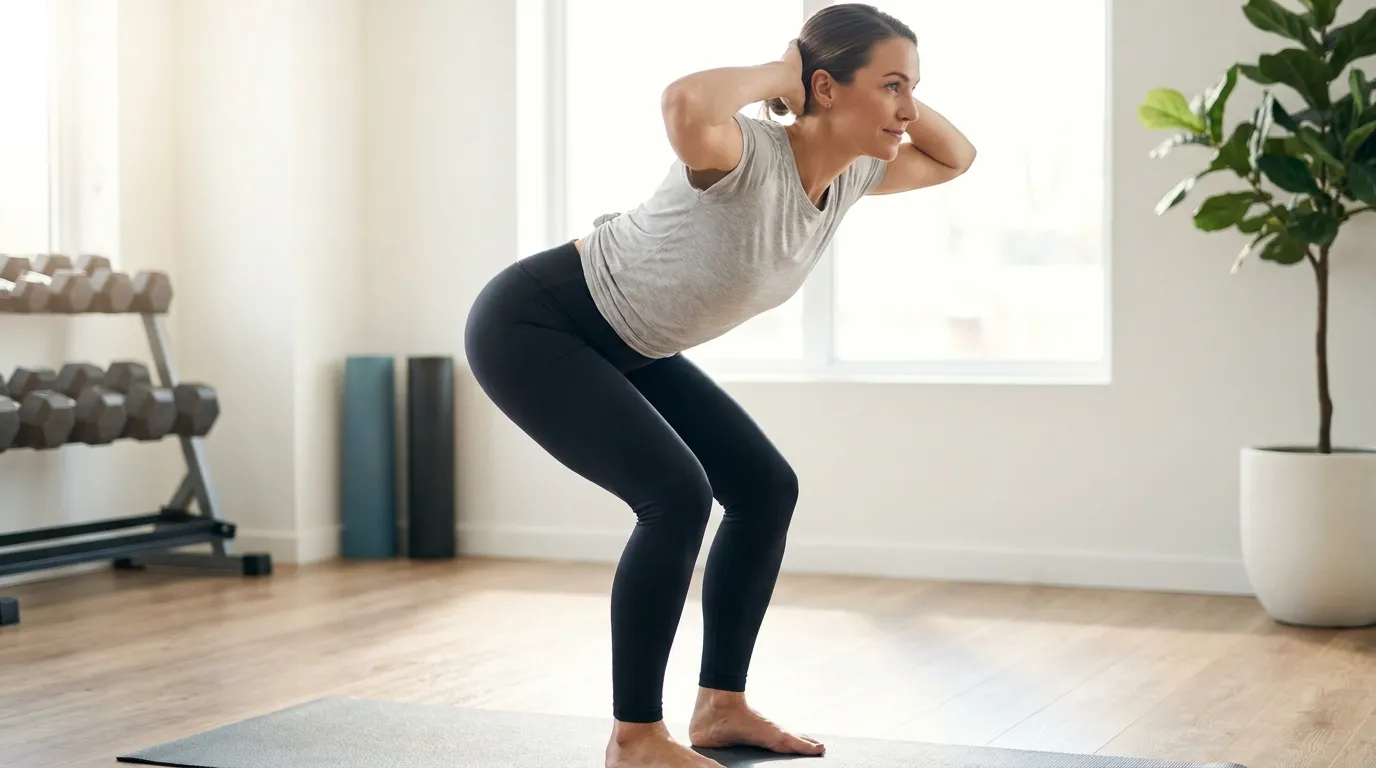
From an upright position, you gently bend your knees and push your hips backward. As the hips travel behind you, your torso leans forward. Once you've reached a comfortable point, you drive the hips forward and return to standing.
Think of the movement as a controlled bow rather than a forward fold.
The distinction matters. A good morning isn't simply about getting your chest closer to the floor. The hips are doing much of the moving, while the trunk stays controlled.
That's why beginners often benefit from practicing without weight. Once the movement starts to feel familiar, resistance can be added if it makes sense for their training.
A barbell is one option, but it isn't essential. Bodyweight good mornings, resistance bands, and light dumbbells can all be used depending on experience and the purpose of the exercise.
Which Muscles Do Good Mornings Work?
The muscles along the back of your body do much of the work during a good morning.
Hamstrings
You'll usually notice the hamstrings as the hips move backward.
These muscles cross both the hip and knee, which allows them to contribute to controlling the hinge. As the torso lowers, the hamstrings lengthen under tension.
That doesn't mean you need to chase an intense stretch. A comfortable amount of tension is enough.
Glutes
The glutes become particularly important as you reverse the movement.
After the hips have moved backward, they help extend the hips and bring you back toward standing. This is one reason the final part of a good morning should feel like you're bringing the hips forward rather than simply lifting your chest.
Spinal Erectors
The muscles running alongside the spine help keep your torso stable while the hips move.
They're working, but that doesn't mean the lower back should be doing all the movement. If the exercise feels like repeated bending and straightening through your lower back, it's worth stepping back and looking at the technique.
Core Muscles
Your abdominal and other trunk muscles contribute to stability as well.
They don't turn the good morning into an abdominal exercise, but they help you maintain control while your body changes position.
The result is a movement that asks several muscle groups to cooperate rather than working one area in isolation.
Why Might Someone Include Good Mornings in a Workout?
One of the biggest reasons to use good mornings is the hip-hinge pattern itself.
Hinging at the hips shows up in plenty of everyday movements. You might use it when picking something up, leaning over to lift an object, or reaching toward something on the floor.
Strength exercises such as deadlifts also rely heavily on hip-hinge mechanics. Good mornings can therefore provide another way to become comfortable with that pattern.
They can also add variety to lower-body training. Squats emphasize a different combination of hip and knee movement, while good mornings place more emphasis on the hinge.
That doesn't make one exercise universally better than another. A good training program can contain different movements for different reasons.
There's also no need to include good mornings simply because they're popular. If another exercise gives you a similar training effect and feels better suited to your body or routine, there's nothing wrong with choosing it instead.
Good Mornings and Mental Well-Being
The connection between this exercise and mental health is indirect.
Good mornings don't have a special psychological effect that separates them from every other form of exercise. What they can offer is a simple opportunity to move.
Imagine spending several hours at a desk. Your body has remained in roughly the same position while your attention has been occupied by work. Standing up and moving through a few controlled exercises can create a small physical break.
For some people, that kind of break becomes part of a useful routine.
Regular physical activity is often discussed as one element of overall well-being, and strength training can be part of an active lifestyle. But it's important not to turn a simple exercise into a promise about mental health.
If someone is experiencing ongoing depression, anxiety, severe stress, or another mental health concern, exercise shouldn't be presented as a replacement for professional care.
A good morning is just an exercise. Its value comes from how it fits into the larger picture.
How to Perform a Good Morning
Before adding weight, spend some time learning the movement itself.
Stand with your feet roughly hip-width apart. Let your arms rest at your sides or cross them comfortably over your chest.
Now soften your knees slightly.
The interesting part starts with the hips. Instead of reaching your chest toward the floor, imagine that you're trying to move your hips backward toward a wall behind you.
As your hips travel back, your torso will naturally tilt forward.
Keep the movement slow enough that you can feel what's happening. Your spine should remain controlled rather than collapsing into a rounded or exaggerated position.
There's no prize for reaching a particular depth. Stop when going farther would make it difficult to maintain the same control.
From there, press through your feet and bring your hips forward. Return to a tall standing position without leaning backward at the top.
The entire repetition can be surprisingly small.
That's perfectly fine.
The purpose isn't to create the biggest possible movement. It's to learn how the hips, legs, and trunk work together.
How Deep Should You Go?
This is where good mornings can become unnecessarily complicated.
People often assume that a deeper hinge must be a better hinge. It isn't that simple.
Your comfortable range depends on factors such as mobility, body proportions, training experience, and the amount of resistance you're using.
Someone may be able to lean considerably farther forward while staying controlled. Another person may reach their useful range much earlier.
Both can perform the exercise correctly.
A practical way to judge the range is to pay attention to what happens as you lower. If your hips stop moving backward and your lower back starts taking over, you've probably gone farther than you can currently control.
Reducing the depth isn't a failure. It simply gives you room to build the movement gradually.
What Should a Good Morning Feel Like?
A good morning will usually create noticeable tension through the hamstrings and glutes.
You may also feel your trunk working as it keeps the torso steady.
Those sensations are different from sharp pain or an uncomfortable feeling in a joint.
Exercise doesn't have to hurt to be effective. If a particular version of the movement causes pain, stop and reassess rather than trying to push through it.
Sometimes the answer is as simple as reducing the range of motion or removing the resistance. In other cases, another exercise may be a better choice.
If you have an existing injury or persistent pain, getting advice from an appropriately qualified healthcare professional can help you determine what type of movement is suitable.
Common Good Morning Mistakes
Good mornings don't require a complicated technique, but a few common habits can change the movement considerably.
Turning the Hinge Into a Forward Bend
The most important distinction is where the movement comes from.
If your hips barely travel backward and your spine does most of the bending, you're no longer getting the same hip-hinge pattern.
A useful way to practice is to stand in front of a wall and gently send your hips toward it. The wall gives you something to aim for and makes the backward movement easier to understand.
Chasing Depth
Trying to reach the floor isn't the goal.
A shorter range with good control can be more useful than a deeper range where your position starts to fall apart.
Over time, your comfortable range may change as you become more familiar with the movement.
Squatting Instead of Hinging
The knees should have some movement, but a good morning isn't meant to become a squat.
If the hips drop toward the floor and the knees travel forward substantially, you've changed the exercise.
Think about the difference between sitting down and pushing your hips backward to close a door.
Locking the Knees
Completely straight knees can make the movement feel unnecessarily stiff.
A slight bend gives the legs room to participate while keeping the emphasis on the hips.
Loading the Exercise Too Quickly
A barbell can make a good morning much more demanding.
There's little reason to rush toward heavy resistance when the bodyweight version still feels unfamiliar. A few controlled repetitions without weight can tell you much more about your technique than adding plates ever will.
Strength should build on movement quality rather than replace it.
Forcing Your Head Up
You don't need to stare straight ahead throughout the entire movement.
Trying to keep your chin lifted can create unnecessary neck tension. Let your head remain comfortably aligned with the rest of your spine.
Can Beginners Do Good Mornings?
They can, provided the exercise is introduced at an appropriate level.
For a beginner, bodyweight practice is usually the easiest place to start. It removes the extra challenge of managing a heavy load while you're still learning the movement.
A wall drill can help, too.
Stand with your back toward a wall, leaving enough space for your hips to move behind you. Slowly hinge backward until your hips approach the wall. Then return to standing.
This isn't a replacement for the actual exercise. It's simply a way to make the hip movement easier to understand.
Once the pattern feels comfortable, you can explore light resistance if it suits your training.
There's no deadline for progressing.
How Many Good Mornings Should You Do?
The answer depends on what you're trying to accomplish.
Someone learning the movement may only need a small amount of practice. Someone using good mornings as part of a strength program may use a different number of sets and repetitions.
For general practice, 2–3 sets of around 8–12 controlled repetitions can be a reasonable starting example.
That isn't a universal prescription.
If your technique starts changing before the set is finished, the number of repetitions matters less than the quality of the movement. Likewise, if you're following a structured strength program, the exercise should fit into the volume and recovery demands of that program.
More isn't automatically better.
Using Good Mornings as a Warm-Up
A few bodyweight repetitions can work nicely before a lower-body workout when the goal is simply to rehearse the hip hinge.
For example, someone preparing for a session involving deadlifts might use several slow good mornings to become aware of the hip movement before beginning the heavier work.
The warm-up should leave you feeling prepared, not tired.
Once you add significant resistance, good mornings become more of a strength exercise. At that point, putting them before another demanding hip-hinge movement may affect how much energy you have for the rest of the session.
The best placement depends on the workout as a whole.
Good Mornings vs. Romanian Deadlifts
Good mornings and Romanian deadlifts share the same broad idea: the hips travel backward while the torso moves forward.
The difference is partly in where the resistance sits.
During a Romanian deadlift, you normally hold the weight in your hands. In a barbell good morning, the load rests across the upper back.
That changes the way the exercise feels and how the body handles the resistance.
Romanian deadlifts may feel more familiar to someone who prefers holding the weight. Good mornings may appeal to someone who wants another way to train the hinge.
Neither needs to “win” the comparison.
The better choice is the one that fits the rest of your program and that you can perform comfortably and consistently.
Good Mornings vs. Squats
Squats and good mornings both belong in the lower-body exercise family, but they ask the body to move differently.
A squat involves substantial bending and straightening at both the knees and hips. A good morning places greater emphasis on moving the hips backward while the torso inclines forward.
That distinction can make them useful alongside one another.
For instance, a workout might include squats for a primary lower-body movement and use a lighter hinge exercise later in the session.
There's no requirement to combine them, though. Exercise selection depends on the rest of your training, your goals, and what you can perform well.
Can Good Mornings Improve Posture?
It's better not to think of posture as one perfect position that you need to hold all day.
Good mornings can strengthen muscles involved in controlling the hips and trunk. They also give you practice maintaining a stable torso while your body moves.
Those qualities may be useful, but they don't make the exercise a guaranteed “posture fix.”
If you spend much of your day sitting, regular movement can be more helpful than trying to hold yourself rigidly in one position.
Standing up, walking around, changing positions, and exercising throughout the day all give your body opportunities to move.
Good mornings can be one small part of that bigger picture.
A Simple Good Mornings Workout
You don't need an elaborate routine to practice the movement.
One straightforward session could look like this:
- Bodyweight good mornings: 2–3 sets of 8–12 repetitions
- Bodyweight squats: 2–3 sets of 8–12 repetitions
- Glute bridges: 2–3 sets of 10–15 repetitions
- Easy walking: a few comfortable minutes afterward
Take enough rest to keep your technique under control.
This isn't a complete strength program, and it won't suit every training goal. Think of it as an example of how good mornings might sit inside a short, accessible workout.
If you're already following a structured program, adding more exercises isn't necessarily an improvement.
How to Progress Without Rushing
Adding weight is only one form of progression.
You might first become more comfortable with the movement. Later, you could improve your control or gradually increase the number of quality repetitions.
Only after that does adding resistance necessarily become useful.
A simple progression might be:
Bodyweight ? consistent technique ? slightly greater challenge ? light resistance ? gradual loading
There's no need to move through those stages on a schedule.
Your body doesn't know what week it is. What matters is whether you can handle the current version of the movement with control.
If a loaded good morning feels unstable, going back to bodyweight practice isn't moving backward. It gives you a chance to strengthen the foundation before making things harder.
Making Good Mornings Fit Into a Busy Day
Not every workout has to happen in a gym.
Someone working from home might stand up after a long period of sitting and perform a few gentle bodyweight repetitions before going for a short walk.
Another person might include them in a normal evening strength session.
Someone else may prefer using them as part of a morning routine simply because that's the time when exercise is easiest to remember.
The exercise doesn't become more effective because the clock says 7 a.m.
What matters more is whether the activity fits naturally into your life.
That can be particularly useful for people who struggle with the idea that exercise has to involve a long, exhausting session. A manageable routine is often easier to repeat than one that constantly feels like another obligation.
When Should You Modify or Skip Good Mornings?
There are situations where good mornings may not be the right choice.
If you have an injury, ongoing back pain, significant joint problems, or another issue that affects exercise, it's sensible to get individual advice before adding a demanding movement.
You might also need to change the exercise if the standard version feels uncomfortable.
Removing the weight is an obvious place to start. A smaller range of motion can also make the movement more manageable.
And sometimes the best modification is simply choosing something else.
No single exercise is mandatory.
Stop if you experience sharp pain, unusual weakness, numbness, dizziness, or another concerning symptom during exercise. When symptoms persist or seem significant, appropriate medical guidance is more useful than trying to diagnose the problem yourself.
Frequently Asked Questions
Are good mornings mainly a back exercise?
Not exactly. Good mornings are primarily a hip-hinge exercise. The hamstrings and glutes contribute to the movement, while the muscles around the spine help stabilize the torso.
Do I have to do them in the morning?
No. The name refers to the movement's appearance rather than a required time of day.
You can include good mornings whenever they make sense within your workout.
Can I perform good mornings without equipment?
Yes. Bodyweight good mornings are a practical way to learn the movement and can provide enough challenge for someone who is new to the exercise.
Why do I feel good mornings in my hamstrings?
The hamstrings help control the hip hinge, so muscular tension in that area is expected.
If what you're feeling is sharp or unusual pain rather than normal exercise-related effort, stop and reassess the movement.
Are good mornings better than Romanian deadlifts?
Not universally. Both train the hip-hinge pattern, but they use resistance differently and may feel different.
The more useful option is usually the one that fits your program and that you can perform safely and consistently.
Can good mornings help with lower-back strength?
The muscles around the spine work to stabilize your torso during the movement. However, good mornings shouldn't be treated as a cure for back pain.
Persistent pain deserves individual assessment rather than a generic exercise prescription.
Can good mornings help mental health?
Exercise can be part of a routine that supports general well-being, but good mornings aren't a treatment for mental health conditions.
If you're dealing with a significant or persistent mental health concern, professional support may be appropriate.
Can I do good mornings every day?
You don't necessarily need to.
Light bodyweight practice may be easier to recover from than loaded training, but frequency should still make sense alongside everything else you're doing.
If good mornings are part of a demanding strength program, recovery becomes more important.
A Better Way to Think About the Exercise
Good mornings aren't impressive because they look complicated. In fact, their simplicity is part of what makes them useful.
The movement teaches you to move your hips while keeping your torso under control. Once that idea becomes familiar, it can make other hinge-based movements easier to understand.
But there's no reason to turn the exercise into a test of flexibility or toughness.
You don't have to reach the floor.
You don't have to use a barbell.
You don't have to perform huge numbers of repetitions.
And you don't have to do the exercise in the morning.
Start with a version you can control. Pay attention to how the hips move. Let your range develop gradually instead of forcing it.
If the movement fits comfortably into your training, it can be a useful addition. If it doesn't, there's no shortage of other ways to strengthen the same general areas.
The best exercise is rarely the one that looks most impressive. It's the one you can perform well, recover from, and continue using as your training develops.